 Forma
Guide › Track it your way
Ways to judge progress
Weight trend, body fat, tape, strength or the Fitness score: what each tells you and when it misleads.
Progress has more than one measure, and each one answers a different question. This page sets out what each measure tells you, what it cannot tell you, and which one to trust when they seem to disagree.
When to use it
- The scale moved but you do not know whether to believe it.
- You wonder what body fat, tape and strength each have to do with the number on Progress.
- You want to know why the Fitness score moved little after a good week.
The measures
Weight trend: the 7-day average
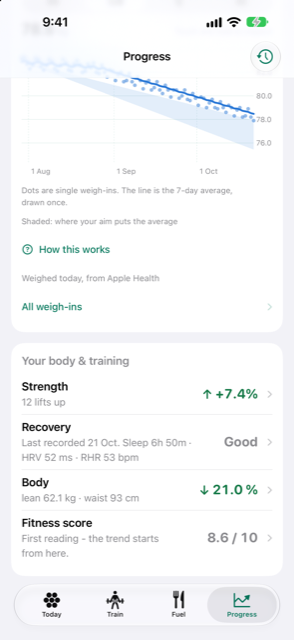
Your weight can move up and down by a kilo or so in a day because of water, food and salt. One weigh-in tells you very little. Forma shows your weigh-ins as dots and the average of the last 7 days as a line. The average shows the real direction; single weigh-ins are for the record.
The average also drives your verdict at the top of Progress. It compares your pace per week with the aim for your goal: -0.75 to -0.50 percent of bodyweight a week on a cut, -0.25 to +0.25 maintaining, and +0.25 to +0.50 on a bulk. A loss faster than the "too fast" line is where muscle starts to go.
The average needs weigh-ins to work. A week with none means no current average; one new weigh-in restarts it. You do not need a reading every day.
Body fat
The Body row on Progress holds your body fat and lean mass: readings from Apple Health, clinic scans you add, and an estimate from your tape. A scale or a clinic scan is preferred. The tape estimate is only a second opinion.
Your goal (eat up, hold or cut) is decided from this number against a range that depends on your sex: women under 18 percent eat up, 18 to 23 hold, over 23 cut; men under 10 eat up, 10 to 15 hold, over 15 cut. Tap Why this goal on that screen to see your own range and the working.
It misleads when devices change. Different devices read differently, so keep using the same one, and read the direction over several weeks rather than the exact level.
Tape measurements
A full tape is all six sites (waist, neck, chest, upper arm, thigh, hips) in one sitting, once a month. Waist and neck also give the body-fat estimate that sits next to your other readings.
If you skip a site, the entry is kept, but it does not reset the monthly clock. The tape misleads when you compare one month with the next too closely. An arm does not grow much in 28 days; several months of tape is the real signal.
Strength
History & reports shows Sets per muscle for your week; around 10 to 20 sets a week for each muscle is the range most people build in. Each lift is shown as an estimated one-rep max from your best set each day.
The estimate misleads if you read it as a real maximum. It is a trend line: only the direction matters, and the same lift over time is what to compare.
The Fitness score
The Fitness score gives each area a score out of 10 and one number across them. It is slow on purpose: every area looks at the last 28 days, and one snapshot is saved a week. Sleep and protein need at least 7 nights or 7 logged days before they count. A body-fat reading older than 120 days stops counting and shows as out of date. When you are cutting, keeping your lifts about where they were (down no more than 2 percent) still scores Good or better for Strength.
A worked example
Sam (88 kg, on a cut) weighs in each morning. Two weeks of weigh-ins look like this (each average is the mean of the readings from the last 7 days, including that day):
| Date | Weigh-in (kg) | 7-day average (kg) |
|---|---|---|
| 26 Oct | 88.4 | 88.40 |
| 1 Nov | 87.9 | 88.31 |
| 4 Nov | 87.5 | 88.04 |
| 8 Nov | 87.1 | 87.60 |
Single weigh-ins jump around by half a kilo or more (88.9 then 88.1 on back-to-back mornings), while the average moves smoothly. On 8 Nov the average is 87.60; a week earlier (1 Nov) it was 88.31. That is a change of -0.71 kg, or -0.81 percent of bodyweight per week. The cut band is -0.75 to -0.50, so the verdict class is "faster than aim": the loss is a little quicker than planned. Forma keeps "too fast" as a separate verdict, and a loss past that line is where muscle starts to go.
Good to know
Related
Something unclear or missing? Write to support@raveniq.ai and say which page.