 Forma
Guide › Progress
Weight and the 7-day average
Why one weigh-in means little and the average means a lot.
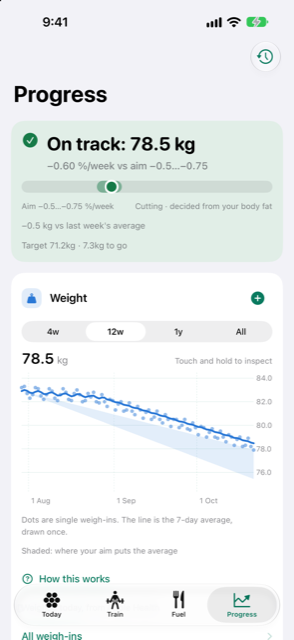
Body weight can move by a kilo or so in a single day because of water, food and salt. One weigh-in tells you very little. Forma works from the average of your last 7 days: a steady line that shows the real direction.
When to use it
- You are cutting, maintaining or gaining, and you want to know whether the pace is right.
- One weigh-in jumped up or down, and you want to know whether to believe it.
- You want your calorie and protein targets to follow your real weight, not one morning's reading.
Step by step
- Tap Add weigh-in on Today, or the plus on the Weight card on Progress.
- Enter your weight and save.
Apple Health can also bring weigh-ins in from your smart scale, so you never type anything.
A worked example
Sam weighs 88 kg and is on a cut. Sam weighs in each morning from 26 October to 8 November 2026. The average for a date is the mean of the readings in the last 7 days including that date. The first days therefore use fewer readings.
| Date | Weigh-in (kg) | 7-day average (kg) |
|---|---|---|
| 26 Oct | 88.4 | 88.40 |
| 30 Oct | 88.0 | 88.40 |
| 1 Nov | 87.9 | 88.31 |
| 4 Nov | 87.5 | 88.04 |
| 6 Nov | 87.3 | 87.81 |
| 8 Nov | 87.1 | 87.60 |
On 8 November the average is 87.60 kg. A week earlier, on 1 November, it was 88.31 kg. That is a change of -0.71 kg, or -0.81% of bodyweight per week.
Single weigh-ins jump around by half a kilo or more (88.9 one day, 88.1 the next), while the average moves smoothly.
Forma puts your pace against a band, in percent of bodyweight per week:
| Goal | Aim band (% per week) |
|---|---|
| Cut | -0.75 to -0.50 |
| Maintain | -0.25 to +0.25 |
| Bulk | +0.25 to +0.50 |
At -0.81, Sam's week is just past the fast end of the cut band, so the verdict at the top of Progress reads faster than aim.
Good to know
- On the Weight card, dots are single weigh-ins and the line is the 7-day average. Single weigh-ins are for the record. Decisions use the average.
- The verdict depends on your goal. On a cut, it can read on track, faster than aim, too fast, slower than aim, stalled, or moving the wrong way. A loss faster than 1% of bodyweight per week crosses the "too fast" line, where muscle starts to go. Changes smaller than about 0.1% per week count as flat.
- The average moves your calorie and protein targets. It also feeds the verdict at the top of Progress, which compares your pace per week with the pace you aim for.
- If you go a week without a weigh-in, there is no current average until you add one. One new weigh-in restarts it.
- Forma stores one weigh-in per day. If a scale reading and a hand-entered value both come in for the same day, the newer one takes its place.
- The average is worked out again from your full history each time you look at it, so it can never drift.
- Every two weeks, Forma checks what actually changed against what it predicted, and can raise or lower your daily calories. If the trend is inside half a kilo of what was predicted, it leaves your targets alone.
Related
Something unclear or missing? Write to support@raveniq.ai and say which page.